Friday, March 19, 2010

Chem 101

It's a funny thing about chemistry. In the real world, it's a science. In the sports world, it's about as far from being a science as you can possibly get. Its workings are intangible, its effects are unquantifiable. And yet, sportswriters--particularly baseball writers--argue time and time again that it's an essential ingredient for a successful team.


Now, make no mistake--this is incorrect. Almost every action in baseball requires zero-to-minimal chemistry, because it requires zero-to-minimal interaction with your teammates. Hitting is individual. Fielding is individual (sure, you have to toss the ball to your teammate for a putout, but...come on). Pitching involves some sense of a bond between pitcher and catcher, but much of what determines success or failure comes down to whether or not the pitcher, all on his own, throws a good pitch. If the left fielder and first baseman hate each other, things will be fine. Even if the pitcher and catcher hate each other, things will probably be fine.


And yet, even when it does come to something as simple as two players throwing the ball to each other, writers insist that there's some element of chemistry that affects the outcome. Today's example comes from Peter Abraham of Boston.com, and you can just sense the fact that he was handed an assignment he didn't believe in and didn't want to write:


"Scutaro, Pedroia, and the rest of the Red Sox enjoyed their only day off of spring training yesterday. For the two infielders, that meant a break from taking countless ground balls and refining their on-field partnership.


Tentative at first, they now exchange the ball like two basketball players on a fast break. Pedroia spins, Scutaro dips, each knowing what the other will do before it happens."


It must be Pedroia's strong baseball instincts that allows him to know, BEFORE IT EVEN HAPPENS, that Marco Scutaro will catch the ball when he throws it.


To be fair, double plays do involve positioning, footwork, etc., and I have no doubt that Scutaro and Pedroia can anticipate their partner's moves before he makes them. But isn't that because every team in professional and amateur baseball runs that play basically the same way? This isn't football; there's no tea playbook that Marco Scutaro needs to learn when switching teams, at least not when it comes to turning the DP. As excited as Peter Abraham (or Peter Abraham's editors) seem to be about the budding chemistry between Scutaro and Pedroia, if Scutaro simply closes his eyes and pretends that Pedroia is Aaron Hill, he'll do fine. 


"From afar, the choreography of a double play seems impossibly intricate as the ball arrives at the bag at the precise second needed to complete the turn. But both Pedroia and Scutaro say it’s not as complicated as fans would think or as time-consuming to master.

'You get that question a lot: What is the chemistry going to be like?’' said Pedroia. 'Everybody wants to know that. But when you get two good players, it comes fast.'"


I think it's fair to summarize this quote as, "We get this question a lot, but it's really no big deal." When the people you're quoting are basically telling you not to write your article, I think it's time to find a new topic.


EDIT: It's a good thing that Tinker, Evers and Chance, the most famous double-play combination of all time, had such great chemistry.

Thursday, March 11, 2010

If A Stadium Collapses And There's No One Around To Be Angry...

I just wanted to chime in that this:


Seemed like a good occasion to reiterate this:


However, read it while you can--in the spirit of the Yankees, I will soon be destroying all of the older posts in this blog's illustrious history. They just don't make me as much money as I'd like.

Tuesday, March 9, 2010

Rearranging The Deck Chairs In The Divisions

http://sportsillustrated.cnn.com/2010/writers/tom_verducci/03/09/floating-realignment/index.html?eref=sihp

SCENE: Special committee's office, Major League Baseball Headquarters, Park Avenue, New York. Fourteen men in suits sit around a coffee table littered with coffee mugs. A Major League Baseball logo placard decorates the far wall. The chair of the meeting stands at the head of the table, below the logo.

MEETING CHAIR: Okay, guys, listen up. Bud wanted us to get together because we have a problem. Our sport has a huge economic and competitive imbalance. HUGE. The good teams are about five times richer than the bad teams. Can you believe that? Five times as much money. They're also, as you'd imagine, significantly better. I mean, sure, sometimes the poorer teams make the playoffs, but they usually don't, and they almost never win the World Series, and they NEVER establish any lasting success. So, I mean, we're supposed to restore the competitive balance, but really, we should probably find some way to give the teams an equal or close to equal amount of money, and start with that. Because really, the roots of this thing are economic, and if we fix that, the competitive balance should follow naturally. So--we need to overhaul this entire system and find a way to share this wealth, really get in-depth with our revenue system. Any ideas?

MEETING ATTENDEE #12: What if we just shuffled the divisions? It would cut down on divisional rivalries. People hate divisional rivalries, right? Isn't that a thing?

MEETING CHAIR: YES. I like it. Let's adjourn. Any thoughts on dinner?

MEETING ATTENDEE #4: Tapas?

MEETING CHAIR: Love tapas.

(Exeunt. On the wall, the white-silouhetted man on the MLB logo placard sheds a single white-silouhetted tear for the state of his league.)

Thursday, March 4, 2010

paul millsap serves notice

okay, so boozer somehow dodged the trade deadline and is still a member of the utah jazz. no matter - he can't stay in that starting lineup forever.

today, paul millsap served notice via espn.com's john hollinger, as a member of the writer's "nba in-season all-improved team." every day, more and more people are realizing that millsap gives you way more bang for your buck. so why keep paying for boozer?

not a good day for the blue devil alums. especially not after that excruciating loss to the terps.

Thursday, February 25, 2010

Alternate Philosophy

All right, it's time for thought experiment number two. So far, among most people with whom I've shared my rules for sporthood, my second rule has been met with much more contention than the first. Now, to be clear, I do still agree with that rule (these are just my personal rules, so it would be tough for me not to agree with them), but it has yet to win the hearts and minds of the public. So, in the spirit of offering an olive branch to our loyal fans, I present to you:

Alternate Rule 2: To be a sport, an activity must define its success objectively rather than subjectively. This requires some clarification, because there is a lot of subjectivity in all sports. Did the runner touch home plate, or not? Did the sprinter beat his competitor by a few thousandths of a second, or lose by that same margin? You could argue that all attempted judgments of these types of close calls are subjective.

However, the crucial distinction is that, whether or not our judges, umps and referees can always find it, there IS an objective answer to these questions. The athlete DID touch home plate, and if he's called out, that's a regrettable error. The runner DID win the race, even if it's too close for us to tell accurately. The subjectivity is in the judging, not in the actual sport. The only place you find subjectivity in sports is in some of the more loosely defined rules--did he make a "football move," did the batter attempt to get out of the way of the pitch, etc. Overall, these sports are objective, with some subjectivity thrown in.

That leaves out, once again, figure skating and gymnastics--even under this new rule, they still don't make the cut. These are performances, much more similar to ballet than they are to, say, soccer. The key factor that makes them performances and not sports is the fact that their success is defined subjectively--hence, the creation of this new rule.

So, another option for my fellow sports-definers out there. Maybe this one will be a little bit more popular.

Tuesday, February 23, 2010

Show Your True Colors

Let's say you're a Cavs fan. You're happy. You like your team this year. You have a chance at locking up LeBron and having a guaranteed Most Beloved And Celebrated Athlete Of All Time for your city. You decide you want to wear your team's colors to celebrate.

Let's take a quick look online at what those colors are, shall we?

http://www.nba.com/cavaliers/history/logo_uniform_history.html

Uh oh. Well, it looks like your current colors are red and white, with a little dark green mixed in there, so you could go with that. But, if you want any connection to your team's history (maybe you grew up as a Cavs fan in the 70's or 80's), you'll have to wear black and light blue as well. And orange. And a different shade of blue. And there's some tan in there. Also gold. You might as well just get one of those rainbow afro wigs and cover your bases.

The point is quite simply this: teams change their uniforms around too much. For me, a big part of sports is history. When I watch a sports team, unless it was recently added to the league, I'm witnessing the latest chapter in a long and storied history of the franchise. Sure, some teams (Yankees, Celtics, Packers, etc.) are thought of as being more "historic," but most teams have their history, and they're proud of it. And along with the timeless feel of a team comes the timeless feel of their uniform. Celtic green. Yankee pinstripes. Green Bay green and yellow. They're iconic, just as the teams they represent are iconic.

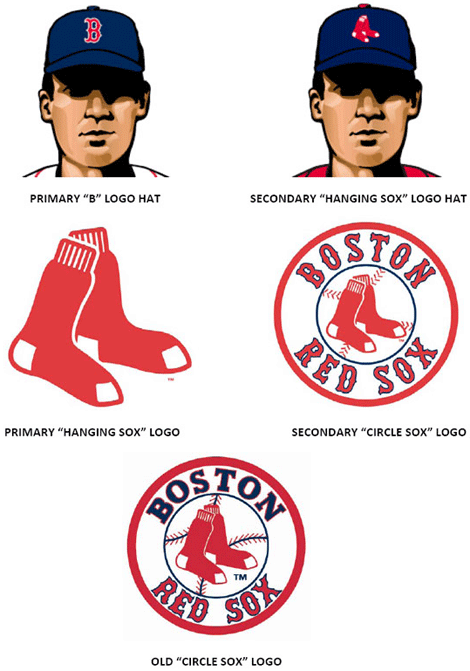
Even for teams that may have a little less history, it's still important to maintain an ongoing connection to their franchise identity. For the Cavs, for example, the biggest chapter in their history may be going on right now. If they change their uniform again in five years, the Cavs of the future will look nothing like the Cavs of yore, the quintessential Cavs. Sure, uniforms, logos, etc., they're all ultimately superficial. But they're still part of your history, and team colors are still a part of your pride, and you shouldn't throw that away and start from scratch just because some guy from marketing suggests that it's a good idea to "rebrand" and make everyone re-buy their LeBron James jerseys. When even the classic Red Sox logo is getting a facelift, it's time to rethink our obsession with reinventing the wheel. If the Yankee pinstripes turn into polka dots, you'll know things have really gone too far.

Monday, February 15, 2010

Let's Get Philosophical

Dark days are upon us, my friends. The football season is over, the baseball season has yet to begin, and basketball is stuck in the doldrums of the All-Star break. With no sports to watch, it provides us at Poop on Boozer with an opportunity to take a step back and reflect on deeper, more profound sports-related questions. Today's edition: what is a sport?

It's not a coincidence that I find myself asking this question as the Olympics begin. Sure, there are Olympic sports we can pretty much all agree actually are sports (hockey, etc.), but is bobsled a sport? Is ski jumping? In examining these questions, I've come up with two essential rules that distinguish true sports from events, exhibitions, spectacles, etc.

Just one thing to note before we begin: classifying a competition as "not a sport" is not necessarily intended to diminish it. Sure, it might be. After all, one of my unofficial litmus tests for whether or not something is a sport is if someone told me, "I'm a professional athlete, I play ____," whether or not I'd have to laugh in their face. If a croquet player told me this, they would not pass that test, so yes, croquet is less tough, less intense, less worthy of athletic respect than, say, basketball. But many activities that will not pass my rules (e.g. logging) are immensely tough--they just aren't sports.

If it's understood that I don't necessarily mean to insult anyone (although don't rule it out), on to the rules:

Rule 1: To be a sport, an activity requires a certain minimum level of exercise and exertion beyond what is normally experienced in day-to-day life. This is what I'm really getting at with my "I'm a professional athlete, I play ____" example from before. The best example here is NASCAR, which passes my second rule (keep reading) for sporthood, and would be a sport if it required any exercise at all, but it does not. Note that an activity can require a great deal of skill (as NASCAR does), but that doesn't make it a sport. International diplomacy requires a great deal of skill. So does knitting. Neither are sports.

Other activities excluded from sport-hood by this rule: golf, luge, bobsled, skeleton, archery, etc.

Rule 2: To be a sport, the activity must force its participants to interact directly with their opponent or opponents. The main intent of this rule is to get rid of "performance-style" sports such as figure skating, gymnastics, ice dancing, ballroom dancing, etc. These activities do pass Rule 1 and are perfectly athletic and tough, but they're performances--more akin to theater or ballet than to football.

I added this rule because, to me, sports isn't just about exercising, it's about strategizing in order to best somebody else. Gymnasts, by and large, do not strategize against their opponents, they strategize against the rings, or the parallel bars, or the pommel horse. Any activity where you are trying to go out and do exactly what you did in practice, and beat a course as best you can, does not fit my definition of a sport. In gymnastics, nobody tries to stop you, and having someone try to stop you is absolutely essential for sporthood.

Another effect of this rule is that some racing-type sports make the cut, but others don't. Swimming and track and field don't--in those sports, you stay in your lane and try to move as fast as possible regardless of what the people in the other lanes do. In cycling, however, you can jockey for position, cut off your opponents, etc., so it earns its right to be called a sport.

As one final note, "direct interaction" doesn't mean physical contact, necessarily. Tennis is a good example--you and your opponent aren't allowed near each other, but you each try to stop the other from doing what they're trying to do, and you have to adapt to what your opponent is doing if you want to beat them. Thus, sport.

* * *

There may be more rules out there, but I've tried to come up with a system that can define sports in as few rules as possible. I'd be curious to know if my colleagues disagree, and if so, how they'd create their system.